Understanding fundamental differences beyond the brochures
Choosing the right international school in China is one of the most important decisions families make when relocating to or living in Qingdao. And for that school with a curriculum that opens a global path for their kids, it is the right approach. If you’re a parent in Qingdao, comparing AP vs IB vs Montessori curricula gives an idea of what these curricula actually mean for your child’s daily life, stress levels, and future opportunities. We here make a neutral, parent-focused comparison between AP vs IB vs Montessori, while also explaining why many internationally mobile families in Qingdao ultimately choose an American AP pathway, such as the one offered at Qingdao No. 1 International School of Shandong Province (QISS).
AP Precalculus had the most significant course launch in the history of the AP Program in 2023-24, with nearly 185,000 exam takers worldwide.
IB VS AP VS Montessori Comparison Chart
| Factor | AP | IB | Montessori |
|---|---|---|---|
| Overall Difficulty | Medium–High (flexible) | Very High (fixed & intense) | Low (early years) |
| Hardest Part | Advanced subjects (Calculus, Physics, Chemistry) | Managing everything at once (EE, TOK, CAS + subjects) | Transition to exams later |
| Learning Style | Structured, subject-based | Inquiry-based, interdisciplinary | Self-directed, hands-on |
| Assessment | External exams + GPA | Internal + external + essays | Observation & portfolios |
| Exam Pressure | Focused, subject-specific | Continuous, system-wide | Minimal (early years) |
| Subjects | The student chooses based on their strengths | Fixed subject groups | Integrated learning |
| Homework Load | Moderate–High (manageable) | High & constant | Low |
| Sports Balance | Good balance possible | Often difficult | Developmental focus |
| Personality Growth | Independence, time management | Resilience, discipline | Confidence, curiosity |
| University Admissions | Powerful (US, Canada, Asia) | Strong (UK, Europe, global) | Indirect pathway |
| Flexibility for Moving Families | High | Low–Moderate | High (early years) |
| Best Age Range | Grades 9–12 | Grades 6–12 | Pre-K to Elementary |
| Best For | Clear outcomes & balance | High academic intensity | Early development |
| Biggest Risk | Overloading with too many APs | Burnout & stress | Academic adjustment later |
Which Curriculum is Hardest Among AP, IB, and Montessori
When parents ask about curriculum difficulty, they’re really asking: “Will my child be able to cope with the course standard?”
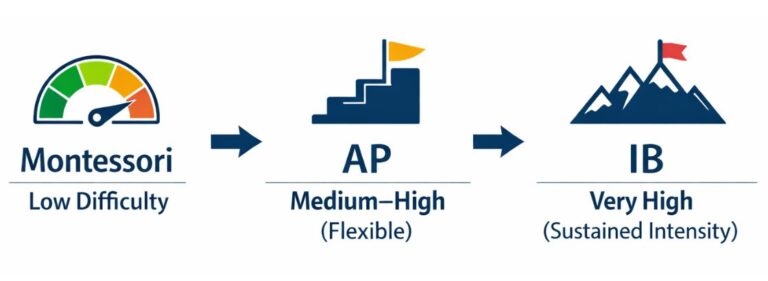
The IB (International Baccalaureate) curriculum is of the hardest intensity. Your child won’t just study six subjects; they’ll write a 4,000-word Extended Essay, complete 150 hours of Creativity, Activity, Service (CAS), and take Theory of Knowledge classes exploring how we know what we know. The diploma requires juggling all of this simultaneously over two years. Students often say the Extended Essay is their biggest challenge, not because it’s intellectually impossible, but because managing a major independent research project while keeping up with regular coursework requires time management skills most 17-year-olds are still developing.
The AP (Advanced Placement) curriculum offers something different: a strategic challenge. Your child might take three AP courses one year, five the next, or focus on subjects they’re genuinely interested in. Each AP course is college-level. AP Calculus BC covers content equivalent to two semesters of university calculus. A student can learn detail syllabus about their passionate subjects while keeping other subjects at the standard level. Students consistently rate AP Calculus BC, AP Physics C (Mechanics and Electricity & Magnetism), and AP Chemistry as the most challenging subjects in the curriculum.
The Montessori curriculum is the easiest among all. They deliberately avoid traditional academic pressure, especially in early years (ages 3-12). Children work at their own pace with hands-on materials. There are no spelling tests to cram for or multiplication tables to memorize by Friday. Instead, a child might spend three weeks perfecting their understanding of fractions using wooden fraction circles, moving on only when they’re genuinely ready. The catch? This gentle approach can create challenges later when students transition to exam-based systems around age 12-14. A child who spent years working independently at their own pace suddenly faces fixed schedules, teacher-led lessons, grades, homework deadlines, and comparative ranking.
Comparing Subject Choices in AP, IB, and Montessori
AP offers roughly 38 subjects, from Computer Science Principles to Art History. Students can choose the subjects according to their interests.
The IB curriculum is balanced by design. Here, students select only one optional subject from six compulsory groups: Language and Literature, Language Acquisition, Individuals and Societies, Sciences, Mathematics, and the Arts (or a substitute).
Montessori does not divide learning into subjects. A single project, such as studying plants, blends science (photosynthesis), language (written observations), art (sketching), and math (measuring growth). This mirrors how young children naturally learn, but it can leave parents wondering whether formal skills, especially in math, are being developed systematically.
Comparing The Fee Structure of IB, AB, and Montessori Curriculum
IB schools in Qingdao typically charge higher tuition fees, often ranging from 150,000 to 280,000 RMB annually for high school. This reflects real costs: IB schools must pay authorization and annual fees to the IB Organization, train teachers in specific IB pedagogy, and maintain smaller class sizes for the discussion-based learning IB requires.
AP schools generally sit between 120,000 to 200,000 RMB annually. The AP curriculum needs a qualified teacher who can teach AP content. The value proposition can be stronger as you’re paying for good teaching and resources, not organizational fees.
Montessori schools vary dramatically. Early childhood Montessori programs (ages 3-6) cost 80,000 to 180,000 RMB annually. However, authentic Montessori secondary programs (ages 12-18) are rare in China, meaning families often invest in Montessori elementary education and then transition to different systems for high school, essentially “starting over” financially and educationally.
Comparing How Your Child Gets Evaluated in IB, AP, and Montessori Schools
Assessment approaches shape your child’s experience more than parents often realize.
Students following the AP curriculum are assessed through traditional letter grades (A through F) for their coursework, contributing to GPA, plus a separate AP exam score ranging from 1 to 5 each May. A student might earn an A in AP Biology class but score a three on the exam, or vice versa. This dual system gives universities both information about sustained performance and standardized external validation.
IB students are evaluated with a much more complex point system. Each subject is scored 0-7, with three additional points possible from the Extended Essay and Theory of Knowledge, creating a maximum of 45 points. But here’s what creates confusion: about 20-30% of each subject grade comes from internally assessed coursework (marked by teachers), while 70-80% comes from external exams. Students receive predicted grades throughout the program, then final grades after exams in May. Universities in different countries interpret these scores differently; a 38/45 might be excellent for one university but insufficient for another.
Montessori students have minimized formal testing in the early years. Children are assessed through observation: Can they complete the work independently? Do they choose challenging materials? Are they developing concentration and persistence? This reduces test anxiety but also means parents sometimes lack traditional benchmarks. When Montessori students eventually face external exams (SAT, ACT, or entrance exams), some adapt easily because they have strong intrinsic motivation, while others struggle with the unfamiliar format.
Comparing Homework Pressure Across AP vs IB vs Montessori
IB students typically face 3-4 hours of homework nightly, more during Internal Assessment seasons. Parents should expect: CAS activities requiring coordination and reflection, Extended Essay deadlines creating weekend work, and Theory of Knowledge essays demanding philosophical thinking. The system assumes students won’t have extensive part-time jobs or intensive sports training. Some students thrive on this structure. They appreciate knowing exactly what’s expected. Others feel constantly pressed, struggling to find time for family, rest, or unstructured creativity.
AP students experience variable homework depending on course selection. A student taking two AP courses might manage with 1-2 hours nightly, while someone taking five APs faces IB-equivalent workloads. The crucial difference between AP vs IB: students and families control this. Having a competitive sports season? Take fewer APs that semester. Passionate about a particular subject? Dive deep with multiple AP courses in that area. This flexibility is why families planning to return to home countries or move internationally often prefer AP. This curriculum adapts to life changes.
Montessori students in authentic programs do most work during school hours. Homework, when assigned, focuses on extending interests (“You were fascinated by that butterfly today, would you like to research more at home?”) rather than completing requirements. This approach respects family time and childhood, though parents sometimes worry their children aren’t being “prepared” for academic rigor.
What Career Pathways Do AP, IB, and Montessori Curricula Prepare Students For?
AP aligns particularly well with medicine, engineering, business, technology, and applied sciences. The subject-specific depth means students graduate with genuine mastery in chosen fields. A student taking AP Biology, AP Chemistry, AP Calculus, and AP Statistics has covered substantial first-year pre-med content. Medical schools in the US and Canada often grant credit for AP scores of 4 or 5, letting students skip introductory courses or graduate faster.
IB aligns particularly well with law, academia, research, international relations, and policy work. The emphasis on critical thinking, multiple perspectives, and written argumentation prepares students for fields requiring the synthesis of complex information. Many universities, particularly in Europe and at liberal arts colleges, specifically value IB’s interdisciplinary approach.
Montessori’s career connection depends entirely on what happens after the early foundation. Montessori advocates point to successful Montessori alumni like Jeff Bezos, Larry Page, and Sergey Brin, attributing their creativity and entrepreneurship to Montessori education. However, all these individuals also attended traditional schools later. Montessori provides excellent early development but requires complementary later education to channel that foundation toward specific career preparation.
University Admissions: What Actually Matters for Parents In China
AP for North American universities: US and Canadian universities thoroughly understand AP. Top universities expect to see AP courses, typically 6-10 APs across four years, for competitive applicants. Many US universities offer course credit or advanced placement for AP scores of 4 or 5, potentially saving families tuition and time. Universities in China, Japan, and South Korea increasingly recognize AP as preparation for their own rigorous programs. The subject-specific depth aligns with Asian university structures, where students typically choose a major upon entrance.
IB for European universities: Many European universities, particularly in the UK, Netherlands, and Switzerland, have specific entry requirements stated in IB points: “32 points with 6,6,5 at Higher Level,” for example. Admissions officers understand exactly what these scores mean. Some UK universities prefer IB to A-Levels because the breadth requirement ensures students haven’t over-specialized too early.
Montessori and admissions: Montessori students applying to universities must demonstrate academic preparation through standardized testing (SAT, ACT) or by attending a traditional high school for their final years. Universities value Montessori for character development, but need proof of academic readiness. This usually works well. Montessori students often have strong intrinsic motivation, but require planning.
Pros of AP, IB, and Montessori Curriculum
AP’s greatest strength: Flexibility without sacrificing rigor. Families can adapt the program to their specific situation, like moving countries, changing goals, or responding to their child’s evolving interests without restarting.
IB’s greatest strength: Proven development of critical thinking across disciplines. Students genuinely learn to analyze arguments, consider multiple perspectives, and construct evidence-based positions.
Montessori’s greatest strength: Children who love learning for its own sake. The early foundation of confidence and curiosity, when protected, creates lifelong learners.
Cons of AP, IB, and Montessori Curriculum
AP’s weakness: Quality varies by school and teacher. Without external regulation, an AP course is only as good as the person teaching it. Parents should investigate: Do teachers have subject expertise? What are the school’s AP exam pass rates? Do teachers actually cover college-level material?
IB’s weakness: Limited flexibility creates real problems for some families. If you move mid-program, finding another IB school and continuing seamlessly is possible, but stressful. If your child discovers a passion that doesn’t fit IB’s balanced requirements, accommodating that passion becomes difficult.
Montessori’s weakness: Not a complete pathway. Families must plan for transitionm, when, how, and to what. Some transitions go smoothly; others create academic or social challenges that take time to resolve.
Which Curriculum to Choose Among Montessori, IB, and AP
Choose AP if:
- Your family might relocate and need a flexible system
- Your child has clear academic strengths that they want to develop deeply
- You value strategic control over academic intensity
- Your child aims for North American or Asian universities
Choose IB if:
- Your family is settled long-term in Qingdao
- Your child handles sustained pressure well and thrives on structure
- You value breadth and want to ensure a well-rounded education
- You’re considering European universities or want maximum international portability
Choose Montessori if:
- Your child is young (under age 9)
- You prioritize emotional development and love of learning over early academic acceleration.
- You can plan for a later transition to a traditional system
- You value childhood and want to protect it from early academic pressure
There isn’t a universally “best” curriculum. There’s the curriculum that best matches your child’s personality, your family’s circumstances, and your long-term goals. The right choice is the one you can commit to and support fully.

If you’re in Qingdao and want to see American-powered AP systems in action, visit QISS during regular hours, talk with current parents, and watch students actually learning, not just touring polished classrooms. Your child will spend thousands of hours in this system; choose thoughtfully.